
The Physics of Champagne Sabering: Why It Works?
Champagne sabering works because a blunt strike at the bottle’s vertical seam concentrates stress at the lip, triggering a rapid crack that internal pressure immediately drives around the neck, cleanly separating the cork and collar without shattering the bottle.
Champagne sabering may look like a theatrical display of force, but the reality is far more precise. What we are witnessing is a controlled fracture event driven by internal pressure, material brittleness, and stress concentration at a known structural weak point.
Champagne bottles contain roughly 70 to 90 PSI of internal pressure generated by dissolved carbon dioxide from secondary fermentation. The bottle’s vertical seam is the weakest structural path in the glass. A sliding strike with Champagne Sabers that impacts the seam at the lip creates a localized stress concentration. This initiates a circumferential crack that propagates instantly around the neck. Internal gas pressure then ejects the cork and glass collar forward as a single unit.
Key Takeaways
- Internal pressure inside Champagne bottles stores enough elastic energy to drive fracture once initiated
- The vertical seam and lip form the bottle’s weakest mechanical junction
- A blunt strike generates stress waves rather than cutting the glass
- Chilled glass fractures cleanly due to increased brittleness
- Internal pressure completes the break and ejects the cork collar
Internal Pressure Inside a Champagne Bottle
Modern Champagne and traditional-method sparkling wines maintain pressure levels between 5 and 6 atmospheres, equivalent to approximately three times the pressure inside a typical car tire. This pressure originates during secondary fermentation when yeast converts residual sugar into carbon dioxide inside a sealed bottle.
Because CO₂ remains dissolved under pressure according to Henry’s Law, the gas stores elastic potential energy within the confined volume. The moment the structural integrity of the bottle neck is compromised, that stored energy rapidly expands outward.
This expansion is what ultimately removes the cork during sabrage. The saber initiates failure. The pressure completes it.
Champagne Bottle Engineering and Structural Weak Points
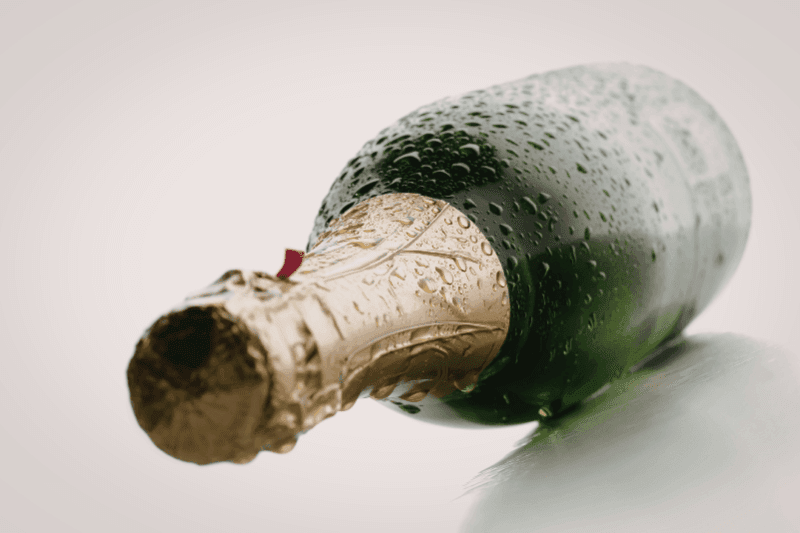 Sparkling wine bottles are engineered from soda-lime-silica glass and manufactured using mold-based forming processes. During production, molten glass meets along vertical mold boundaries, creating one or two seams that run from base to lip.
These seams are microscopic discontinuities in the glass structure. While safe under normal conditions, they behave as stress risers when subjected to impact.
At the bottle lip, the glass thickens into an annular ring designed to resist cork pressure. The intersection of this ring and the vertical seam forms a geometric discontinuity where tensile stress can accumulate. This seam-lip junction becomes the ideal fracture initiation site during sabrage.
Impact Physics and Stress Concentration
Sabering is not a slicing motion. The blunt edge of our Champagne saber slides along the seam, gaining momentum before striking the lip.
This motion transfers impulse rather than penetrating force. Upon impact, stress waves travel through the brittle glass matrix. Because glass lacks plastic deformation capacity, it cannot redistribute the energy. Instead, the stress concentrates at microscopic surface flaws.
Once the local tensile stress exceeds the fracture toughness of the glass, a crack nucleates instantly.
Fast Fracture Propagation
Once the saber strike initiates a microcrack at the seam–lip junction, the failure mechanism transitions from mechanical impact to dynamic fracture propagation. Champagne bottles are made from soda-lime-silica glass, a brittle amorphous material that lacks the ability to plastically deform under stress. Unlike ductile materials such as aluminum or steel, which absorb energy through deformation before failing, glass stores applied stress elastically until its fracture toughness threshold is exceeded.
At the moment of impact, a stress wave travels through the glass wall and concentrates at microscopic surface flaws that already exist along the vertical mold seam. These flaws function as crack nucleation sites. When the localized tensile stress intensity factor surpasses the critical fracture toughness of the glass, rapid crack growth begins.
This crack does not propagate randomly. Instead, it travels circumferentially around the narrowest structural cross-section of the bottle neck. Internal pressure inside the bottle contributes stored elastic strain energy that accelerates crack propagation along this path. In fracture mechanics terms, the pressurized CO₂ gas effectively increases the energy release rate available for crack advancement.
The resulting fracture occurs on the order of microseconds to milliseconds. Because the crack front travels faster than energy can redistribute through the glass matrix, catastrophic fragmentation does not occur. Instead, the neck separates cleanly along a predictable circular path, leaving behind a smooth fracture surface.
Internal pressure is not working against the break. It is actively driving its completion.
Temperature and Glass Brittleness
The temperature plays a decisive role in determining whether sabrage produces a clean circumferential fracture or an uncontrolled structural failure. As glass temperature decreases, molecular motion within the amorphous silica network becomes increasingly restricted. This reduction in atomic-scale mobility limits the material’s capacity to redistribute stress through localized relaxation processes.
In practical terms, colder glass behaves in a more brittle manner. Brittle materials fracture suddenly once their stress threshold is reached, rather than deforming gradually. This is precisely the behavior required for successful sabrage.
Chilling the bottle to approximately 1 to 3°C creates two favorable physical conditions. First, the increased brittleness of the glass promotes rapid crack propagation along the seam instead of dissipating the applied energy across multiple fracture paths. Second, the solubility of carbon dioxide in the wine increases as temperature decreases, which results in a modest reduction in internal gas pressure prior to impact.
This slight pressure reduction stabilizes the bottle long enough for the fracture to initiate cleanly at the intended seam–lip junction rather than triggering uncontrolled stress release elsewhere in the structure.
A properly chilled bottle fractures where we guide it to fracture.
Cork Ejection After Separation
 After circumferential fracture completes, the structural containment of the pressurized system is lost instantly. At this point, the internal gas transitions from a confined dissolved phase into an expanding free phase.
The pressure differential between the interior of the bottle and the surrounding atmosphere drives rapid gas expansion outward through the newly formed opening. Because the cork remains mechanically attached to the severed glass collar by friction and compression, both components are accelerated forward together as a single mass.
Momentum transfer occurs through expanding gas flow, propelling the cork–collar assembly at velocities capable of carrying it 15 to 30 feet from the point of release.
Despite the dramatic ejection, liquid loss is typically minimal. The initial phase of depressurization involves rapid gas escape, which precedes bulk liquid displacement. As a result, the outward flow of CO₂ effectively shields the remaining wine from immediate spillage during the first milliseconds following fracture. If the bottle is not consumed immediately after sabrage, knowing how to recork Champagne properly can help preserve its remaining freshness and carbonation.
Why the Bottle Does Not Explode
One of the most persistent misconceptions about sabrage is that the bottle is somehow “breaking safely” under high pressure. In reality, the safety of the process lies in fracture confinement.
The seam–lip junction acts as a predetermined failure path where tensile stresses can concentrate under impact. Once crack initiation occurs at this location, internal pressure distributes symmetrically around the circumference of the neck. This uniform pressure loading assists crack propagation along a controlled circular trajectory.
Because the crack advances along a single continuous path rather than branching unpredictably, the bottle avoids multidirectional fracture networks that would otherwise result in explosive fragmentation.
In effect, internal pressure helps complete a guided structural separation rather than triggering uncontrolled failure.
The bottle breaks exactly where we guide it to break.
When Sabering Fails
Unsuccessful sabrage attempts typically arise when the conditions required for brittle fracture are not fully established.
Common failure modes include:
- Warm glass exhibiting reduced brittleness and increased stress dissipation
- Off-seam impact that fails to engage a structural weak point
- Hesitation during the strike, reducing impulse transfer
- Repeated tapping motions that distribute energy inefficiently
- Using low-pressure sparkling wines that lack sufficient stored elastic energy
In each of these scenarios, applied stress dissipates throughout the bottle wall instead of exceeding the critical stress intensity factor required for crack initiation.
Materials Science Perspective
From a materials science standpoint, sabrage can be explained using Griffith fracture theory, which describes crack propagation in brittle solids. According to this model, fracture occurs when the energy released by crack growth exceeds the energy required to create new surface area within the material.
Surface imperfections present along the mold seam serve as pre-existing crack nuclei. The saber strike increases the stress intensity factor at these flaws beyond the critical threshold for unstable crack growth. Once this threshold is surpassed, the crack propagates spontaneously through the brittle glass matrix under the influence of stored elastic strain energy.
Modern Bottle Manufacturing Improvements
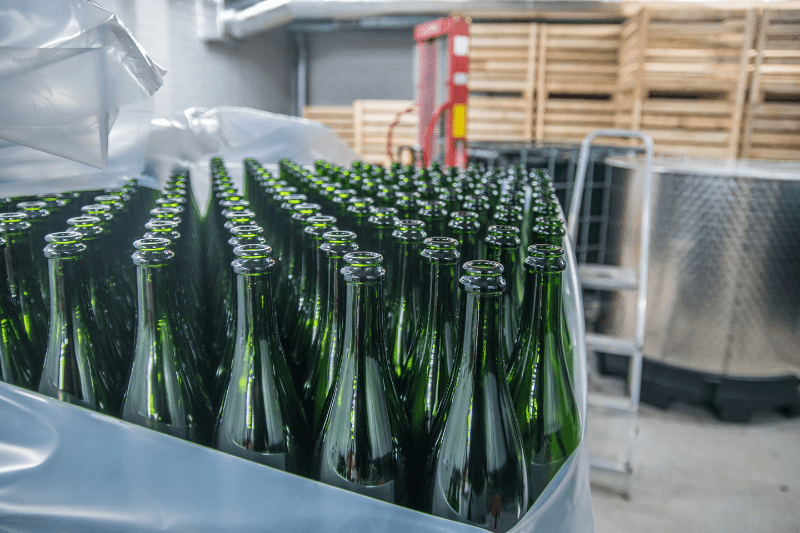 Advancements in automated mold alignment and precision glass forming have improved structural consistency in modern sparkling wine bottles. Contemporary manufacturing processes now produce more uniform seam geometry and enhanced pressure tolerance compared to earlier production methods.
These improvements increase safety margins under normal storage conditions while also making sabrage more predictable when performed correctly with our Champagne saber and other products.
Final Thoughts
Champagne sabering is applied physics expressed through ritual, where thermodynamics, fracture mechanics, and materials science converge in a single controlled event. What appears to be a dramatic act of force is, in reality, the precise manipulation of stored internal energy within a pressurized glass system that is already primed for structural failure along a known weak point.
When we understand how internal carbon dioxide pressure stores elastic strain energy inside the bottle, how mold seams act as stress concentrators, and how brittle materials such as soda-lime glass respond to impulse loading, the outcome becomes far more predictable than theatrical. The saber does not cut the bottle open. It simply initiates a fracture at the seam–lip junction. From that moment forward, the pressurized system completes the process through rapid crack propagation and pressure-driven separation.
This interplay between impact-generated stress waves and pressure-assisted fracture explains why the neck detaches cleanly instead of fragmenting unpredictably. It also explains why temperature conditioning, strike velocity, and seam alignment are not ceremonial preferences but physical requirements for successful sabrage.
Using our Champagne saber and other products with this understanding transforms sabering from a visual spectacle into a repeatable application of mechanical principles. Rather than relying on force or chance, we are guiding a brittle material toward a confined failure path that is already defined by its geometry and internal pressure state.
In essence, sabrage works not because the bottle is broken open, but because it is engineered to fail in exactly the way we instruct it to.
Apply the physics of sabrage with greater strike consistency and fracture control using our Champagne sabers at California Champagne Sabers.
Sources:
Expondo. (n.d.). Opening champagne using the sabrage technique. Expondo UK.
Wikipedia contributors. (2024). Sabrage. In Wikipedia, The Free Encyclopedia.
FAQs
What is the physics of sabering Champagne?
The physics of sabering Champagne involves fracture mechanics acting on a pressurized glass vessel. A bottle of sparkling wine contains approximately five to six atmospheres of internal carbon dioxide pressure, which places continuous tensile stress on the glass walls. When our Champagne saber and other products strike the intersection of the vertical seam and the bottle lip, the impact initiates a crack at this structural weak point. Internal pressure then drives the fracture rapidly around the neck, separating the cork and glass collar in a clean, controlled break.
Why does sabering Champagne work?
Sabering Champagne works because the bottle is already under significant internal pressure from dissolved carbon dioxide. The vertical seam formed during glass manufacturing and the protruding lip of the bottle create a natural stress concentration point. When the blunt spine of a Champagne saber delivers impact at this intersection, the glass fails at its weakest location. The internal pressure inside the bottle then forces the crack to propagate through the neck, ejecting the cork and collar outward without shattering the bottle body.
Is Champagne sabering difficult?
Champagne sabering is not physically difficult but it requires proper preparation and technique. Success depends on aligning the blade with the bottle seam, chilling the bottle to increase glass brittleness, and delivering a smooth, confident motion along the neck. Modern Champagne sabers are designed for balance and controlled momentum transfer, making the process more about precision than strength when performed correctly.
What is the Champagne sabering ritual?
The Champagne sabering ritual, also known as sabrage, originated with Napoleonic cavalry officers who used their sabers to open bottles while celebrating victory. Today, the ritual is performed at weddings, hospitality events, and milestone celebrations as a ceremonial method of opening sparkling wine. Using a Champagne saber transforms the act of opening a bottle into a formalized gesture of celebration rooted in historical tradition.
Why doesn’t glass fall into the Champagne after sabering?
Glass fragments rarely enter the bottle because the internal pressure forces gas and liquid outward at the moment of fracture. This rapid decompression creates an outward flow that helps expel any small shards away from the opening rather than allowing them to fall inside. The first poured glass is typically inspected as a precaution.
Can you saber sparkling wines other than Champagne?
Yes, other sparkling wines such as Cava, Prosecco Spumante, and Crémant can be sabered if they contain sufficient internal pressure. Sparkling wines with higher carbonation levels are more likely to produce a clean neck separation when struck at the seam and lip intersection using a properly balanced Champagne saber.