Champagne Terminology Explained: A Complete Guide to Brut, Demi-Sec, Vintage & More
Understanding how to read Champagne labels opens up an entirely different drinking experience. Many bottles look similar from the outside, yet they vary significantly in sweetness, style, grape composition, ageing, and regional classification. These distinctions influence taste, aroma, texture, food compatibility, and long-term cellar potential. What appears as specialized vocabulary is simply the wine industry’s way of communicating how Champagne was made and what the drinker can expect inside the glass.
While much of the global sparkling wine market uses simplified sweetness categories like dry or sweet, Champagne follows a more technical lexicon defined by law, tradition, and culture. Terms such as Brut, Blanc de Blancs, Vintage, and Grand Cru describe measurable differences and form a useful framework for selecting bottles for specific occasions, meals, or cellaring plans.
Key Takeaways:
- Champagne terminology reflects specific production choices including sweetness level, grape varieties, ageing practices, and terroir. These factors shape flavor, texture, and food pairing behavior.
- Sweetness categories such as Brut, Extra Dry, and Demi-Sec are legally defined by dosage levels and help consumers predict how a Champagne will perform with salty, spicy, savory, or dessert dishes.
- Styles like Blanc de Blancs, Blanc de Noirs, Rosé, and Prestige Cuvée indicate vinification and blending approaches that influence body, acidity, aromatics, and ageing potential.
- Ageing classifications distinguish Non-Vintage, Vintage, and Late Disgorged Champagne, with extended lees contact contributing to complexity, finer mousse, and autolytic notes such as brioche and pastry.
- Producer codes and regional classifications such as RM, NM, Grand Cru, and Premier Cru provide sourcing and origin transparency, allowing buyers to choose based on terroir, house style, or grower expression.
Sweetness Levels: Brut vs Demi-Sec and the Dosage Scale
Champagne categorizes sweetness based on the grams of sugar per liter (g/L) added during dosage, the final step after disgorgement. The scale runs from extremely dry to richly sweet:
Dryest to Sweetest
- Brut Nature (0–3 g/L) – Virtually no sugar. Extremely dry, lean, and mineral-driven.
- Extra Brut (0–6 g/L) – Very dry but slightly more balanced. Subtle roundness without tasting sweet.
- Brut (0–12 g/L) – Dry and the most common style. Allows a wide range of flavors and food pairings.
- Extra Sec / Extra Dry (12–17 g/L) – Slight sweetness despite the confusing name. Good with salty or mildly spicy foods.
- Sec (17–32 g/L) – Noticeably sweet on the palate. Works with pâté, pastries, and lightly sweet snacks.
- Demi-Sec (32–50 g/L) – Sweet and often served with desserts or richer dishes.
- Doux (50+ g/L) – The sweetest category. Rare today and decidedly dessert-like.
Brut Nature
No detectable sweetness. Crisp, linear, highly mineral-driven. Appeals to drinkers who prefer precision and tension over roundness.
Extra Brut
Barely perceptible sweetness balancing acidity without creating a sweet impression. Favored for pairing with raw shellfish and lean seafood.
Brut
The most common category worldwide. Technically dry yet broad enough to accommodate richness, toastiness, or fruit depending on producer style.
Extra Sec / Extra Dry
Slightly sweet despite its contradictory name. Historically popular for aperitifs and lighter canapé service.
Sec
Noticeably sweet and often suited for spicy foods or lightly sweet pastries.
Demi-Sec
Dessert-leaning profile with preserved fruit, floral, and pastry notes.
Doux
The sweetest category. Quite rare today but historically dominant in 19th-century Champagne consumption.
Champagne Styles: Blanc de Blancs, Blanc de Noirs, Rosé & Cuvée Categories
Beyond sweetness, Champagne communicates production style through vinification terminology.
Blanc de Blancs
Made exclusively from white grapes—almost always Chardonnay.
Profile: high acidity, lemon zest, green apple, chalk, white flowers, and long-term ageing potential.
Blanc de Noirs
Made from black grapes (Pinot Noir and/or Meunier) but pressed gently to avoid pigment extraction.
Profile: richer texture, red fruit notes, more structure on the palate.
Rosé Champagne
Two primary methods are permitted:
- Assemblage (blending still red wine into white base wine)
- Saignée (briefly bleeding color from maceration)
Rosé offers aromatics of strawberry, cherry, raspberry, and occasionally spice or tannin depending on technique.
Cuvée & Prestige Cuvée
“Cuvée” simply refers to a particular blend, though in Champagne it can indicate higher quality selections.
“Prestige Cuvée” or “Tête de Cuvée” denotes a house’s flagship bottling, often sourced from the best vineyards and aged extensively.
Organic, Biodynamic, and Vegan
Modern demand has introduced new distinctions:
- Organic avoids synthetic vineyard treatments.
- Biodynamic follows holistic agricultural cycles.
- Vegan avoids animal proteins during fining.
Producers vary widely in certification and philosophy.
Grape Varieties and Blends
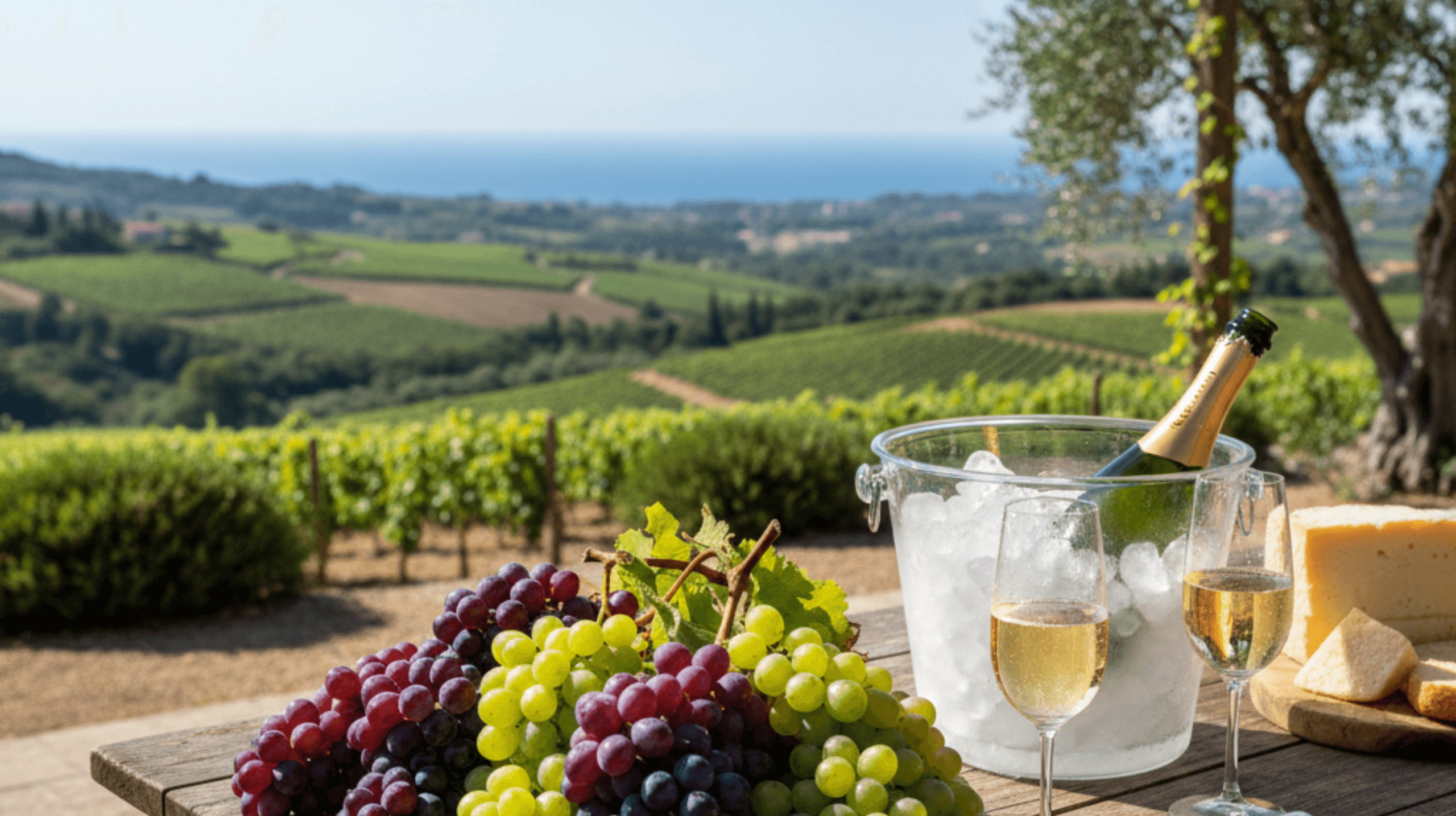
Three main grapes define Champagne:
- Chardonnay — citrus, chalk, precision, long ageing
- Pinot Noir — body, structure, red fruit, power
- Meunier — roundness, orchard fruit, early approachability
Most houses blend across grape varieties and villages to maintain consistent style, especially in non-vintage bottlings. Single-variety cuvées emphasize terroir and technique.
Vintage, Non-Vintage & Ageing Classifications
Ageing is central to Champagne’s identity and legal framework.
Non-Vintage (NV)
The vast majority of Champagne. Blends multiple harvest years for style consistency.
Minimum ageing: 15 months, including 12 on lees.
Vintage (Millésime)
From a single declared year and produced only when the harvest meets stylistic standards.
Minimum ageing: 36 months on lees, often much longer.
Multi-Vintage / Perpetual Reserve
Uses a fractional system resembling a solera to blend many years continuously, resulting in unusual depth and complexity.
Late Disgorged
Extended lees ageing post-fermentation, often producing brioche, pastry, hazelnut, and autolytic notes.
These classifications influence texture, mousse, longevity, and aromatic evolution.
Producer Categories and Label Codes
Champagne includes a system of two-letter codes specifying producer type:
- NM — Négociant-Manipulant – Large houses buying grapes and blending widely.
- RM — Récoltant-Manipulant – Grower-producers making wine from their own vineyards.
- CM — Coopérative-Manipulant – Cooperatives pooling resources for vinification.
- RC — Récoltant-Coopérateur – Growers using cooperative facilities but bottling under their own label.
- MA — Marque d’Acheteur – Private labels bottled for third-party brands.
- ND — Négociant-Distributeur – Merchants bottling and distributing purchased wines.
Consumers increasingly explore RM bottlings for terroir transparency, while NM houses remain dominant for global consistency.
Regional Classifications and Terroir
Champagne’s historic vineyard ranking is based on the Échelle des Crus system:
- Grand Cru – These villages were historically rated at the highest price level and are regarded for producing grapes of exceptional concentration, balance, and ageing potential. Only seventeen villages qualify for this status, and many prestige cuvées are sourced from these sites.
- Premier Cru – A broader group of high-performing villages that have historically commanded strong grape prices and consistent quality. Premier Cru wines can offer excellent value and terroir character compared with Grand Cru bottlings.
- Autre Cru – The remaining classified villages within Champagne that vary widely in soil, exposure, and microclimate. These vineyards supply much of the fruit used for non-vintage blends and house-standard cuvées.
Grand Cru and Premier Cru villages are prized for their historical quality and grape pricing advantages. Terroir also varies across key sub-regions:
- Montagne de Reims (Pinot Noir strength) – A cooler plateau with chalk-rich soils that favors Pinot Noir and produces structured, mineral, and age-worthy wines with firm acidity.
- Vallée de la Marne (Meunier dominance) – A river valley with more varied soils and cooler pockets that suit Meunier, resulting in fruit-forward, approachable wines that tend to drink well sooner.
- Côte des Blancs (Chardonnay purity) – A linear ridge of chalk that excels with Chardonnay and yields citrus-driven, high-acid wines with notable finesse and long-term cellaring capacity.
- Côte des Bar / Aube (rising star, Pinot Noir driven) – A warmer southern area with limestone soils that favor aromatic and expressive Pinot Noir. The region has grown in prominence, especially among smaller producers and single-vineyard bottlings.
These distinctions inform flavour, structure, and ageing potential.
Disgorgement, Dosage & Technical Vinification Terms
Champagne vinification requires several unique steps:
- Tirage — addition of yeast and sugar to create secondary fermentation in bottle.
- Lees Ageing — yeast breakdown contributes texture and autolytic aromas.
- Riddling (Remuage) — gradual rotation of bottles to collect sediment.
- Disgorgement — expulsion of sediment under pressure.
- Dosage — small addition of sweetened wine determining final sweetness level.
Extended lees ageing generates mousse finesse, brioche notes, and creamy textures associated with fine Champagne.
Bottle Size Terminology
Champagne uniquely names its larger formats, and each size influences how the wine matures and how it is used for service or celebration.
- Half Bottle (375 mL) – Convenient for individual servings and small pours, often used in tasting menus or single-occasion consumption.
- Standard (750 mL) – The most common format for retail and restaurants and the reference size used for most production and ageing comparisons.
- Magnum (1.5 L) – Linked to superior ageing due to the balance between wine volume and oxygen ingress. Frequently chosen for collectors, cellaring, and extended maturation.
- Jeroboam (3 L) – Equivalent to four standard bottles. Suitable for events and larger tables. Ageing effects are slower than standard formats.
- Methuselah (6 L) – Equivalent to eight standard bottles and often used for ceremonial pours and festive occasions rather than long-term cellaring.
- Salmanazar (9 L) – Equal to twelve standard bottles. Rarely produced and typically reserved for grand celebrations, gala events, and hospitality displays.
- Balthazar (12 L) – Equal to sixteen standard bottles. Primarily ceremonial and associated with high-visibility service environments.
- Nebuchadnezzar (15 L) – Equal to twenty standard bottles. The largest traditional format most consumers encounter, used almost exclusively for public celebrations and presentation value.
Magnums are particularly prized for ageing because they provide a favorable ratio between oxygen exposure and wine volume, which preserves bubble finesse and supports slower aromatic development. Larger formats are typically reserved for service impact rather than cellar performance, since they are more difficult to store and move and are produced in smaller quantities.
Food Pairing by Sweetness and Style
Sweetness levels in Champagne influence how the wine interacts with salt, acid, fat, and spice. The following framework summarizes common pairings based on sweetness and production style.
By Sweetness
- Brut Nature / Extra Brut → These very dry styles pair well with oysters, sashimi, caviar, and other raw seafood. The high acidity and lack of residual sugar highlight salinity and texture without overwhelming delicate flavors.
- Brut → The most versatile category for meals, working well with poultry, creamy cheeses, fried foods, and scallops. Brut offers enough roundness to handle richer textures while remaining dry enough for savory dishes.
- Extra Dry / Sec → These slightly sweet styles complement spicy foods, pâtés, and light pastries. The touch of sweetness softens spice and salt while enhancing richness.
- Demi-Sec / Doux → These sweet styles pair effectively with fruit-based desserts, foie gras, and blue cheese. The sweetness balances salt and fat and harmonizes with dessert sweetness levels.
By Style
- Blanc de Blancs → Often best with shellfish and acidity-driven dishes. The citrus and mineral profile accentuates seafood freshness and cuts through lean or tart preparations.
- Blanc de Noirs → Well suited to richer proteins and roasted poultry. The deeper fruit character and fuller body match more savory and textural dishes.
- Rosé → Combines acidity and red fruit character, pairing successfully with charcuterie, tuna, duck, and umami-rich foods. The subtle tannic structure from red grapes supports more flavorful preparations.
Understanding the Language of Champagne
Champagne’s terms are far more than stylistic labels. They communicate how the wine was grown, blended, aged, and finished, and they offer clues about flavor, texture, and suitability for different foods or occasions. Once the vocabulary becomes familiar, bottles that once appeared similar reveal meaningful differences. Sweetness levels indicate structure and pairing potential, grape varieties signal body and aromatic profile, and classifications point to provenance and ageing paths. Learning this language transforms Champagne from a single celebratory icon into a diverse category with nuance, depth, and remarkable range to explore.
At California Champagne Sabers, we curate a growing collection of Champagnes that represent different styles, sweetness levels, and regional expressions. We also offer a dedicated selection of Champagne sabers designed for ceremonial service and sabrage, allowing enthusiasts to enjoy the tradition from both a tasting and celebratory perspective.